For the better part of fifty years, the dumpster rental industry operated on a simple, stubborn principle: “If it ain’t broke, don’t fix it.” It was a world built on handshake deals, carbon-copy triplicate forms, and dispatchers who kept the entire fleet’s schedule stored in their heads. The barrier to entry was buying a truck; the barrier to success was just working harder than the guy across town. Technology was viewed with suspicion—something for the “suits” in corporate offices, not for the operators with grease under their fingernails.
But the tectonic plates of the waste management industry have shifted. We are currently living through an extinction event for the “pen and paper” hauler. The market has evolved. Customers have evolved. And most importantly, the competition has evolved. Today, innovation isn’t just a shiny add-on; it is the only survival gear left.
The modern dumpster business is no longer a logistics company that happens to use computers; it is a data company that happens to own trucks. The operators who understand this shift are scaling to seven figures with lean teams and high margins. The ones who don’t are slowly bleeding out, losing jobs to competitors who can quote, book, and bill in the time it takes the old guard to find a working pen. Here is a deep dive into the specific innovations that are reshaping the landscape, and why clinging to the past is the fastest way to kill your future.
1. The “Cloud Command” Center: Why Your Whiteboard is Costing You Thousands
There is a certain nostalgia to the giant dispatch whiteboard. It’s physical. It’s tactile. But in terms of efficiency, it is a dinosaur. The problem with a whiteboard is that it is static. It cannot see traffic jams. It cannot predict that a driver will get stuck at the landfill for an extra 45 minutes. It cannot instantly re-route a truck when an urgent pick-up request comes in from your biggest contractor.
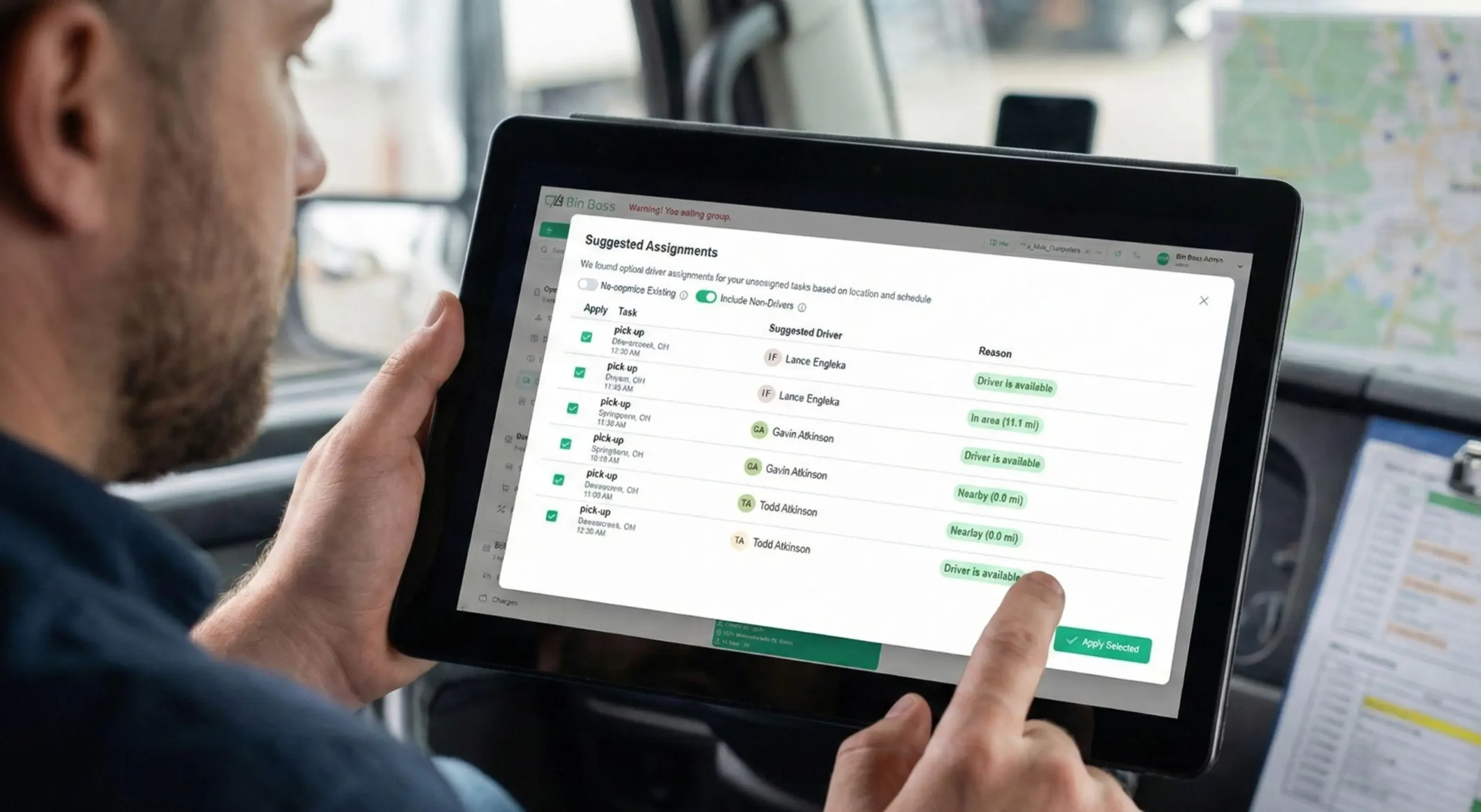
Innovation has replaced the whiteboard with the “Cloud Command” center. Modern software solutions like Bin Boss utilize dynamic, real-time mapping that serves as the brain of your operation. This isn’t just about knowing where your trucks are; it’s about “Tetris-ing” your day for maximum profitability.
When you operate in the cloud, your dispatch board becomes a living organism. If a driver finishes a drop early, the system highlights the nearest available pick-up, potentially squeezing an extra haul into the day. In this business, one extra haul per truck, per day, is the difference between surviving and thriving. Innovation allows you to visualize your efficiency gaps and close them instantly, something a dry-erase marker simply cannot do.
2. The Weaponization of Search: Dominating the Digital Landfill
In the old days, “marketing” meant painting your phone number on the side of the can and maybe sponsoring a Little League team. If you had the biggest yellow page ad, you won. Today, the battlefield has moved entirely to the screen in your customer’s pocket. When a homeowner realizes they need a dumpster for a renovation, or a contractor lands a roofing job in a new zip code, they don’t look for a phone book. They ask Google.
This transition has birthed a new kind of innovation: specialized digital warfare. It is no longer enough to just “have a website.” You need to occupy the digital real estate that matters. This is where generalist marketing agencies fail. They try to rank you for generic terms, wasting your budget on clicks from people looking for “trash cans” or “garbage bags.”
True innovation in this sector comes from partnering with a dedicated dumpster seo company that understands the nuances of the trade. They know the difference between “roll-off” and “front-load” search intent. They understand seasonality—how to push concrete washout bins in the spring and residential cleanout bins in the fall. This targeted, data-driven approach to visibility is what allows a local hauler to outmaneuver national giants who are too slow and too broad to compete on a neighborhood level.
3. The “Amazon Effect” and the Expectation of Instant Gratification
We live in an era of instant gratification. Your customers can order a car, a meal, or a new television with three taps on their phone. When they call a dumpster company and get a busy signal, or are told “we’ll call you back with a quote,” they don’t wait. They move on to the next result on the list.
Innovation has brought the “Amazon Effect” to waste management. Modern software integrates instant quoting and online booking directly into your website. This means your business is open 24/7. While you are sleeping, your software is selling. A customer can visit your site at 11:00 PM on a Tuesday, select a 20-yard dumpster, sign the rental agreement digitally, and pay via credit card, all without a human interaction.
This isn’t just convenient; it is essential. By automating the intake process, you free up your dispatchers to focus on high-value tasks, like managing commercial accounts or solving complex logistics problems, rather than answering the question “How much for a 30-yarder?” for the fiftieth time that day.
4. Frictionless Driver Tech: The “Combat Simple” Philosophy
For years, the biggest hurdle to adopting technology was the driver. And frankly, the drivers were right to complain. Early iterations of fleet software were clunky, requiring drivers to peck at tiny keyboards or navigate complex menus while wearing work gloves. It was friction, and friction slows down the truck.
The current wave of innovation has embraced a “Combat Simple” design philosophy. The best tools are now designed with the reality of the job site in mind. We are talking about apps that require zero typing. One tap to clock in. One tap to arrive. One tap to snap a photo of the bin placement (saving you from those inevitable “you cracked my driveway” claims).
By respecting the driver’s workflow, this technology ensures compliance. When the app is easy, the data gets entered. When the data gets entered, the office knows exactly what is happening in the field. This synchronization eliminates the frantic game of telephone between dispatch and drivers, reducing stress and increasing safety.

5. Automated Revenue Recovery: Plugging the Leaks
The silent killer of dumpster businesses is “revenue leakage.” This happens in the margins: the 1.5 tons of overage you forgot to bill for because the landfill ticket got lost in the cab. The extra three days a customer kept the bin that you didn’t charge for because you lost track of the drop date. The dry run fee you waived because you felt bad, even though the car was blocking the driveway.
Innovative software acts as a ruthless accountant that never sleeps. It automates the “boring” but profitable parts of the business. When a driver inputs the landfill weight, the system automatically calculates the overage based on the specific customer’s contract and queues up the charge. It tracks rental days with stopwatch precision and automatically triggers daily rental fees the second the contract expires.
This isn’t about nickel-and-diming customers; it’s about getting paid for the work you actually did. These automated systems recover thousands of dollars a month in lost revenue—money that goes straight to the bottom line without you having to sell a single additional dumpster.
6. The Shift from “Gut Feeling” to Predictive Analytics
Ask an old-school hauler how business is, and they’ll say, “Busy.” Ask them which zip code is their most profitable, or what their average fuel cost per haul is on a Tuesday versus a Friday, and they will stare at you blankly. Running a business on “gut feeling” works when you have two trucks. It is suicide when you have twenty.
The final, and perhaps most powerful, innovation is the democratization of data. You no longer need a degree in statistics to understand your business health. Modern dashboards present complex data in plain English. They tell you which customers are slow payers, which bin sizes have the highest turnover velocity, and which drivers are the most fuel-efficient.
This innovative approach allows you to make decisions based on facts. You might realize that while your 40-yard dumpsters bring in big revenue numbers, they sit on job sites too long, making your 15-yard dumpsters the actual profit kings due to higher turnover. Armed with this knowledge, you stop buying equipment you don’t need and start optimizing the assets you have.
The Bottom Line: Innovate or Evaporate
The era of the “rough and tumble” dumpster business is ending, replaced by the era of the “smart and scalable” logistics operation. The tools available today—from AI-driven routing to automated SEO engines—are powerful force multipliers. They allow a small team to do the work of a large corporation.
But these tools are only as good as the mindset of the owner using them. Innovation requires a willingness to change, to learn, and to let go of the “old ways” that feel comfortable but are ultimately holding you back. The future belongs to the haulers who look at a smartphone and see a piece of heavy equipment just as vital as the truck itself. The industry is moving forward with or without you—make sure you’re in the driver’s seat.
Also Read-Why Tech-Savvy Designers Are Turning to Virtual Tools for Better Results
